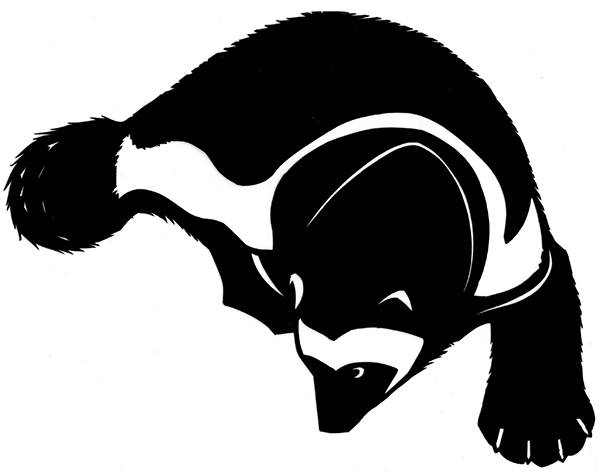

Wolverines of North America (Gulo gulo luscus) are a mid-size carnivore belonging to the weasel (Mustelidae) family, known for their tenacity, territoriality, and a fascinating life history tied to snowy landscapes. Populations are recovering in the southern extent of their range following human persecution and predator control programs during the 20th century, which caused local extinction in Washington’s Cascade Mountains. Biologists estimate the current population to be roughly 30-40 individuals within the North Cascades Ecoregion.
As a species that relies on persistent snow cover through the denning season in order to safely raise young, the primary long term threat to wolverines in their southern range is the loss of dependable spring snow, due to the warming climate. Additionally, wolverines face cumulative challenges associated with habitat fragmentation and degradation such as roads, development, and recreation.
Wolverines are federally listed as a threatened species in the contiguous United States under the Endangered Species Act. As such, trapping, harassing, or otherwise intentionally harming wolverines is a federal offense. Wolverines are rarely encountered in the wild and are not known to be aggressive towards humans.

Appearance
An adult wolverine is roughly the size of a small bear or a medium-sized dog, with large feet and a bushy tail. Including the tail a wolverine measures 34 – 42 inches in length (85 cm – 105 cm). The tail alone is 7 – 10 inches long (18 – 25 cm). A typical female weighs 18 – 27 pounds (8 – 12 kg) while an adult male weighs 24 – 42 pounds (11 – 19 kg). Occasionally confused with other wildlife, a wolverine is about twice the size of a hoary marmot, much smaller than an adult bear, and has darker fur, longer legs, and a longer tail than a badger. Their heads are broad and rounded with an elongated snout, small dark eyes, short rounded ears and a light colored face mask.
Their dense pelage (fur) is composed of underhair and guardhair, appearing as thick and glossy dark brown. A pale buff or blonde stripe extends along the wolverine’s sides from the neck to the base of the tail. Individual wolverines are discernible by their chest blazes, which are uniquely shaped patches of blonde or light fur on the chest.
Habitat
Wolverines are a Holarctic species, occurring at northern latitudes in North America and Eurasia. At the southern limit of their range, including the Cascades, they live primarily in subalpine regions. They rely on persistent spring snowpack for denning locations where females raise young. Wolverines are considered an indicator species, meaning that their presence on the Pacific Northwest landscape provides a measure of mountain ecosystem health, as well as as a sign of adequate connectivity to habitat beyond the Cascades. With the loss of spring snowpack due to the warming climate, the lower elevations of suitable habitat are expected to diminish over time. View a map of wolverine habitat suitability changes at Terradapt.
Wolverines often keep to high elevation alpine tundra and subalpine forest but may also descend to forage or disperse. In recent years wolverines have been observed crossing interstates, coastal beaches, the Great Salt Lake and other barriers, presumably to seek out new territories or mates. Home range size depends on habitat quality and the availability of food. Individual home ranges may vary from 115 – 580 square miles (300 – 1500 km2) with males keeping larger territories than females.
Reproduction and Denning
During the summer breeding season wolverines mate with non-monogamous partners. Females exhibit delayed implantation, giving birth to kits in February when conditions are suitable, which may not occur every year. Litter sizes average two to three kits. Mother wolverines raise their kits during the heart of winter inside snow dens, which protect young from cold temperatures and predation. Boulders and fallen trees provide additional structure to some dens. Dens are often found near or below treeline, in ravines or drainages, near avalanche paths, or in snow covered talus or boulder fields. The denning period, from February to May, is the most vulnerable part of a wolverine’s life cycle. Human disturbance and lack of snow can disrupt this critical period.
Wolverine kits wean in 9 – 10 weeks and begin to travel with their mothers in early summer. By September, juveniles are nearly full grown and may take on more independence. Male wolverines are sexually mature at two years and females at 15 months. The high energetic costs of reproduction and low resource availability in wolverine habitat presumably contribute to wolverines’ low reproductive rate.
Commonly Misidentified Species

Black bear: Cubs may be similar in size to wolverine and adults much larger. Tail is very small, often unnoticeable.

Wolverine: Head more elongated than a bear. Brownish overall with a noticeable light stripe of fur along the sides of its back. Distinctive blazes on chest. Medium sized bushy tail. Moves with a distinctive loping gait.

Badger: Lighter colored overall with long fur along the sides and a low-slung appearance. Distinctive striping on the head and face.

Hoary marmot: About half the size of a wolverine. Grayish overall with portions of the head darker than the body. Lacking the distinctive light stripes along the sides of its back. Often seen lounging in the sun or running among meadows and talus fields.

For more wolverine ecology and natural history visit these websites: